Heart Voice.
A Somatic Practice

This is heart’s constant project: transmuting fear into love.
— Elisabeth Rochat de la Vallée
The Practice of Heart Voice
Slowing the speech, and letting the words rise from the chest instead of the head
Most of us speak from the neck up. Words get generated in the thinking mind — quick, clipped, already three sentences ahead of themselves — and the voice becomes an extension of that mental noise: fast, a little tight, aimed at being understood or agreed with or finished. Heart Voice is a different way of speaking entirely. It's the practice of pausing long enough for the words to travel down out of the head, settle in the chest, and rise back up already warmed by contact with the heart. The pace slows. The tone drops and softens. And what comes out tends to be simpler, truer, and far more felt by whoever is listening.
This isn't a metaphor I'm reaching for loosely. There's real physiology underneath it, and there's a long lineage in Chinese Medicine that names this exact relationship between the Heart and the voice. Below is what's actually happening in the body when we do this, and a practice you can use to begin training it.
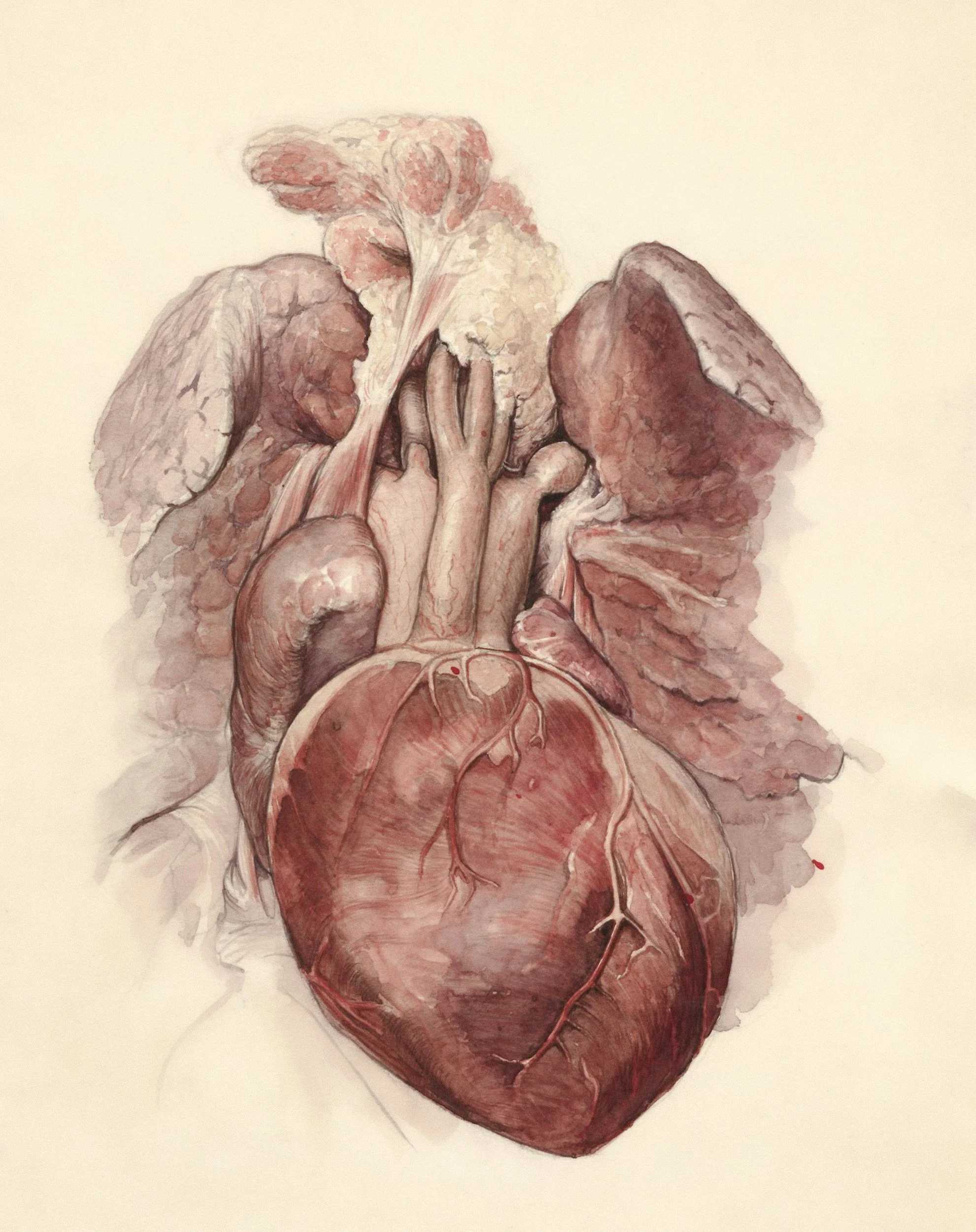
Head Voice vs. Heart Voice
Head voice is what most of us default to under any kind of pressure — a work call, a hard conversation, a room full of people. It tends to be fast, slightly breathless, pitched a little high, and oriented toward getting the sentence out rather than getting it true. It's the voice of the nervous system in a mild state of alert, even when nothing is actually wrong.
Heart Voice is slower almost by definition — you cannot rush it and still call it Heart Voice. It has more space between words. It tends to drop in pitch and resonate lower in the chest rather than staying high in the throat and sinuses. It often includes pauses that would feel uncomfortable in head voice, because there's no urgency driving it — the words aren't trying to outrun anything. People on the receiving end of it almost always describe it the same way: they feel met, rather than talked at.
Why the Body Can Tell the Difference
This distinction isn't just a poetic one — the nervous system registers it directly. Polyvagal Theory describes a specific branch of the vagus nerve, the ventral vagal complex, that coordinates the muscles of the face, throat, and larynx together with the heart. This same circuitry that slows the heart rate in moments of safety is the circuitry that shapes vocal prosody — the pitch, rhythm, and warmth of a voice (Porges, 2011). In other words, a slower, lower, warmer voice isn't just a style — it's a physiological signal, generated by an actual nerve pathway, that tells both the speaker's body and the listener's body that it's safe to soften.
That works in both directions. Research on speech rate and vocal tone has found that faster, louder speech reliably tracks with fear and anxiety, while slower, softer speech tracks with calmer emotional states (Siegman & Boyle, 1993) — meaning the pace of your voice isn't only an effect of your nervous system's state, it can also become a lever for it. Slowing the voice on purpose is one of the few nervous-system tools that works from the outside in.
There's also real research on the heart's own electrical field and its relationship to felt states of coherence and calm. The HeartMath Institute's work on heart rate variability coherence has shown that steady, rhythmic heart patterns — the kind cultivated through slow breath and a settled body — correlate with clearer thinking and a more regulated emotional state. Heart Voice, practically speaking, is a way of letting that coherence reach the vocal cords before the words do.
The Chinese Medicine View
In Chinese Medicine, the Heart is said to house the Shen — the spirit, the quality of consciousness that looks out through the eyes and animates the voice. Classical texts describe the Heart as opening into the tongue, and speech itself is considered one of the most direct outward expressions of the Shen's condition. A Heart that is settled produces speech that is unhurried and clear. A Heart that is agitated, overworked, or carrying too much — what's often described as Shen disturbance — tends to show up as speech that's scattered, too fast, too loud, or strangely flat. From this lens, Heart Voice isn't a communication technique so much as a way of listening to your own Shen and letting your speech reorganize around a calmer center.
The Practice of Heart Voice
Anchoring the Voice in the Heart Body
Settle the body. Sit or stand with your feet grounded and your spine long but not rigid. Let your shoulders drop away from your ears. Take three slow breaths, making the exhale longer than the inhale.
Find the chest. Place one hand on your sternum, over the physical heart. Breathe as though the breath is moving in and out of that spot, not just the lungs. Stay here for 4–5 breaths, letting your attention settle under your hand.
Speak one true sentence, slowly. Choose something simple and honest — not composed, not clever. "I'm tired." "I care about you." "I don't know yet." Say it at half the speed you'd normally use, with a pause before and after. Notice where you feel it land in your body as you say it — chest, throat, belly.
Notice the difference. Head voice usually wants to keep going, to explain, to justify. Heart Voice tends to feel complete after one sentence. If you notice the urge to keep talking, that's often head voice re-entering — you can pause, return your hand to your chest, and start again.
Bring it into real conversation. The real practice isn't the exercise — it's carrying this pace into an actual difficult moment: a hard phone call, a conversation with a partner, a check-in with yourself. The moment you feel your speech speeding up or rising in pitch, that's the cue to drop back into the chest before the next sentence. The goal is to be in Heart Voice as often as possible.
Ask for support. It also helps to enlist someone you trust — a partner, a friend, a family member — and pick a fun, low-stakes code word together (something silly works best, like 'turtle' or 'slow your roll' or “blueberry pancakes”) that either of you can say gently the moment you notice your speech speeding back up into the head, as an easy, judgment-free way of asking for support in coming back to the heart.
A Gentle Closing Note
Heart Voice is simple to describe and genuinely difficult to sustain, because it asks you to slow down in a culture that rewards speed. It won't feel natural every time, especially under real pressure — and that's expected, not a failure of the practice. Like any nervous-system skill, it strengthens with repetition, not with getting it right the first time. If you'd like to explore this practice more deeply — including how it connects to the Heart's Shen in a Chinese Medicine framework, or how it can support you through somatic or acupuncture work — I'd love to work through it with you in a session.
Sources
Polyvagal Theory: Current Status, Clinical Applications, and Future Directions, PMC
Polyvagal Theory, Chapter 10–13 (Porges, 2011), Nalanda Contemplative Psychotherapy Program
Cardiac Vagal Tone: A Neurophysiological Mechanism That Evolved in Mammals, PMC
From Dysregulation to Coherence: Exploring the HeartMath Approach, PMC
The Vagus Nerve and Voice, National Center for Voice and Speech (NCVS)
Resonant Breathwork as Multimodal Vagal–Interoceptive Modulation, Lindenwood University
I first discovered the practice of Heart Voice through a Whole Heart Connection workshop with Thea Elijah.

"The heart (xīn 心) has the charge of sovereign and master (jūn zhǔ 君主). Spiritual brightness (shén míng 神明) stems from it."
— Huangdi Neijing Su Wen, Chapter 8, cited via Elisabeth Rochat de la Vallée