The Healing Power of Bone Broth:
Nourishment for the gut, the joints, the bones, and the deepest reserves of the body
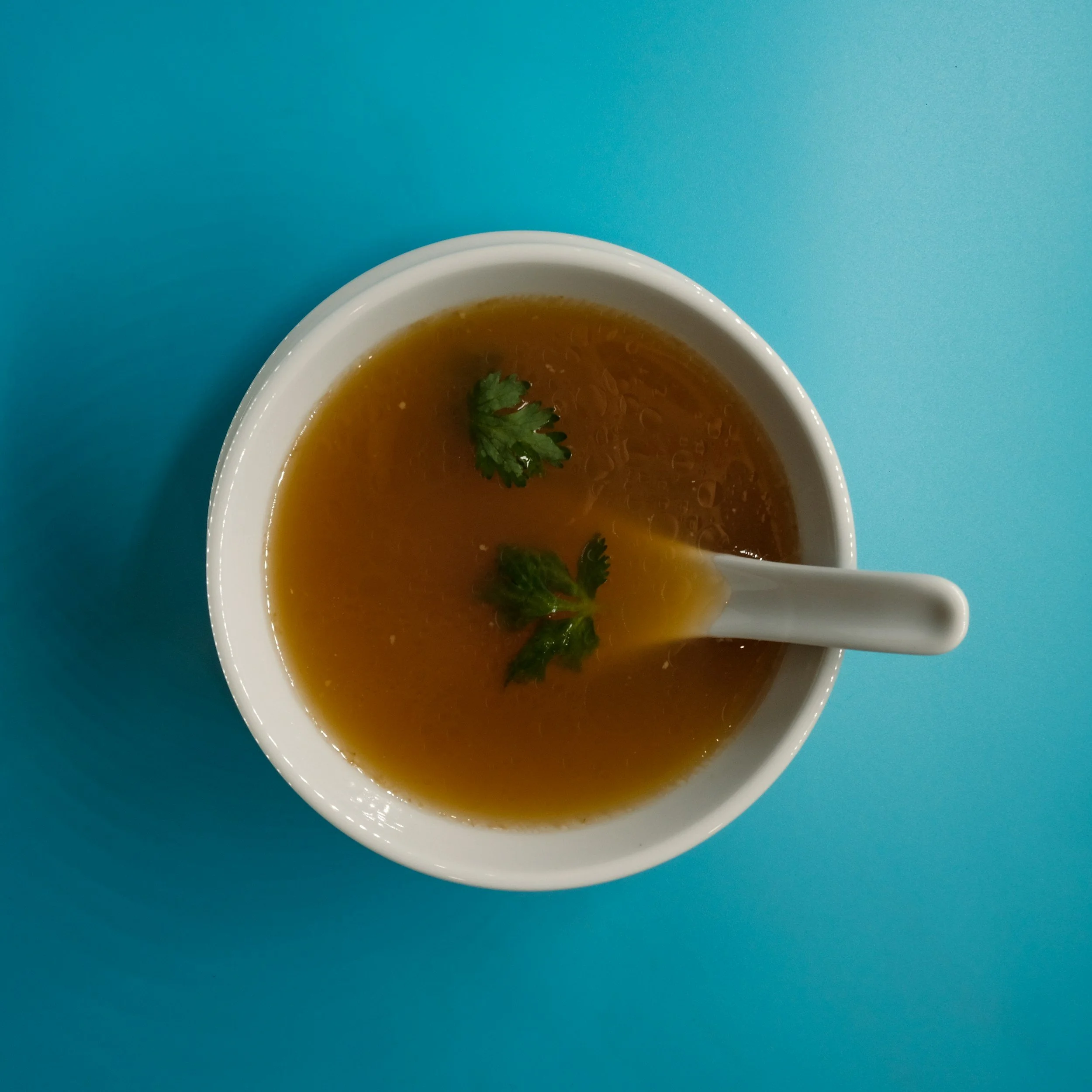
A gentle food for a body in repair
There are foods that simply feed us, and there are foods that seem to tend to us — quietly rebuilding what has been depleted, softening what has grown inflamed, warming what has gone cold. Bone broth belongs to this second category.
In Chinese Medicine, long-simmered broths made from bone and marrow are prized as ways of nourishing the Kidneys and Jing — our deepest reserves of essence — and building Blood.
In modern nutrition, that same slow-cooked liquid is understood as a source of collagen, gelatin, amino acids like glycine and glutamine, and minerals drawn out of bone over many hours of gentle heat. If you are living with digestive struggles, auto-immunity, joint pain, or a diagnosis of osteoporosis or osteoarthritis, bone broth is not a cure — and I want to be honest with you about that. But it can be a real, tangible way to bring warmth, minerals, and reparative building blocks to a body that is working hard to heal. Below is what the research actually shows, how this fits within a Chinese Medicine view of the body, and four recipes you can bring into your own kitchen.
Bone Broth & Gut Health
A gut that is inflamed, irritated, or in need of repair often does best with foods that are easy to digest and rich in the specific amino acids the intestinal lining uses to rebuild itself. Bone broth supplies glutamine, glycine, and proline — amino acids that support the integrity of the gut barrier and help regulate inflammation. A 2025 review in Digestive Diseases and Sciences found that these components may help maintain intestinal barrier function and reduce inflammation, particularly relevant for conditions like inflammatory bowel disease. Animal studies on bone broth's anti-inflammatory effects in colitis models showed reduced inflammatory markers and less tissue damage. It's worth saying clearly: human clinical trials on bone broth itself (rather than its isolated components) are still limited, and some researchers caution against treating it as a guaranteed fix for gut issues. What we can say is that it is a warm, easily digested, nutrient-dense food — and in a Chinese Medicine framework, warm, cooked, well-simmered foods are traditionally considered gentler on a Spleen and Stomach that are already taxed. For many people with sensitive digestion, that alone makes broth a welcome addition.
Sources — Bone Broth & Gut Health
Bone Broth Benefits: How Its Nutrients Fortify Gut Barrier — PubMed (2025)
https://pubmed.ncbi.nlm.nih.gov/40180691/
Analysis of the Anti-Inflammatory Capacity of Bone Broth in a Murine Model — PMC
https://pmc.ncbi.nlm.nih.gov/articles/PMC8618064/
Bone Broth: Benefits, How To Make and Nutrition — Cleveland Clinic
https://health.clevelandclinic.org/bone-broth-benefits

Bone Broth & Joint Comfort (Osteoarthritis)
This is where the evidence is strongest. Bone broth is a natural source of collagen and gelatin, which break down into amino acids the body uses to maintain cartilage and connective tissue. While there are no large clinical trials on bone broth specifically for arthritis, there is a meaningful body of research on its key components:
A meta-analysis of collagen supplementation found it effective in reducing osteoarthritis symptoms, improving both pain scores and function. A double-blind, placebo-controlled trial on hydrolyzed collagen found significant reductions in joint pain and stiffness, with improved mobility after eight weeks of daily intake. A systematic review in Nutrients concluded that collagen supplementation shows consistent, positive effects on pain relief and joint function across multiple studies, though study designs vary.
The caveat: collagen in bone broth isn't in the same concentrated, hydrolyzed form used in most research studies, so a cup of broth is not equivalent to a measured collagen supplement. Still, it's a real source of the same raw materials, and glycine itself — abundant in bone broth — has anti-inflammatory properties and is linked to better sleep, which matters enormously for anyone managing chronic joint pain. In Chinese Medicine terms, the Kidneys govern the bones and the sinews depend on nourished Blood and Jing — broth is one of the more direct ways to feed that system through food.
Sources — Bone Broth & Joint Comfort (Osteoarthritis)
Effect of Collagen Supplementation on Osteoarthritis Symptoms: A Meta-Analysis — PubMed
https://pubmed.ncbi.nlm.nih.gov/30368550/
Double-Blind, Randomized, Placebo-Controlled Trial on Hydrolyzed Collagen — PMC
https://pmc.ncbi.nlm.nih.gov/articles/PMC8308696/
Collagen Supplementation for Joint Health — Nutrients / PMC
https://pmc.ncbi.nlm.nih.gov/articles/PMC10058045/
Is Bone Broth Really Brimming With Health Benefits? — The New York Times
https://www.nytimes.com/2024/10/15/well/eat/bone-broth-health-benefits.html
Bone Broth & Bone Health (Osteoporosis)
I want to be especially careful here, because this is where bone broth is most often oversold. Bone broth does not reverse osteoporosis, and its calcium content is actually lower and more variable than many people assume — minerals don't transfer from bone to broth as efficiently as marketing suggests. It is not a substitute for adequate dietary calcium, vitamin D, weight-bearing movement, or medical care. That said, it isn't nothing. Bone broth does contain calcium, phosphorus, magnesium, and other minerals involved in bone metabolism, along with collagen peptides that make up the protein matrix bone is built on. Animal research has found that concentrated bone broth supplementation improved bone healing and callus density after fracture, and other animal work on chicken-vegetable bone broth found compounds that appeared to slow osteoporosis progression. These are early, preliminary findings — not proof for humans — but they point toward bone broth as one reasonable piece of a bone-supportive way of eating, especially alongside the other pillars of bone health. From a Chinese Medicine lens, this is Jing-nourishing, marrow-building food: something you weave into your rhythm over time, not a fix you reach for once.
Sources — Bone Broth & Bone Health (Osteoporosis)
Bone Broth and Bone Health: What the Science Actually Says — Bones After 50
https://www.bonesafter50.com/bone-broth-bone-health/
Bone Broth Benefits: How Its Nutrients Fortify Gut Barrier — PubMed (2025)
https://pubmed.ncbi.nlm.nih.gov/40180691/
Effect of Concentrated Bone Broth on Bone Healing in Rabbits — IASJ
https://iasj.rdd.edu.iq/journals/uploads/2024/12/09/40c21f691520aa818a1712ee565fa7dc.pdf
Hyaluronan and Chondroitin Sulfate in Chicken-Vegetable Bone Broth and Osteoporosis Progression — PubMed
https://pubmed.ncbi.nlm.nih.gov/38317402/
Broth & Fatigue, Jing Deficiency & Convalescence
Fatigue that lingers, slow recovery after illness or surgery, or the deep depletion Chinese Medicine calls Jing deficiency all point to the same thing: reserves that need rebuilding, not just symptoms to manage. This is arguably bone broth's oldest and most traditional use — long before "gut health" or "collagen" entered the conversation, broth was the food given to the weak, the recovering, and the newly postpartum.
In Chinese Medicine, Jing is our deepest reserve — the essence inherited at birth and slowly spent through stress, illness, overwork, and age. It lives in the Kidney system and governs energy, recovery speed, and resilience. You can't manufacture Jing, but you can protect and slowly replenish it through rest and through dense, warm, well-cooked food — which is exactly what a long-simmered broth is. Foods that specifically nourish Jing and Kidney essence include black beans, black sesame seeds, walnuts, goji berries, and jujube (red dates) — several of which appear in the recipe below.
On the modern nutrition side, chicken bone broth in particular is considered the classic postpartum and convalescent staple in Chinese dietary therapy, prized for glycine, proline, glutamine, and histidine dipeptides that are easy to absorb when the digestive system is weak or taxed. A well-known 2000 University of Nebraska study on traditional chicken soup found it had a measurable ability to inhibit the migration of neutrophils, a mechanism that may explain its mild anti-inflammatory effect during colds and respiratory illness. And more broadly, warm cooked foods like broths and congees are considered easier on digestion than raw or cold foods, which frees up the body's resources for healing rather than digesting.
As always, the honest caveat: broth alone doesn't reverse Jing deficiency or replace rest, sleep, and appropriate medical care during recovery from serious illness or surgery. But as a daily, sippable source of warmth, amino acids, and minerals for a body that is rebuilding itself, it's one of the most traditional and reasonable tools available.
Sources:
Chinese Herbal Bone Broth: A Slow Cooker Recipe for Recovery — Dr. Eric Higashino
https://drhigashino.com/chinese-herbal-bone-broth/
Jing (精) — Vital Essence and Foundation of Reproduction — Yin Shi
https://yinshi.app/en/blog/jing/
20 Qi-Building Foods + 8 Recipes for Qi Deficiency (TCM) — Yao Shan Guide
https://yaoshanguide.com/qi-building-foods-qi-deficient-diet
The Healing Benefits of Soups and Stews — Naomi Whittel
https://naomiw.com/blogs/nutrition/the-healing-benefits-of-soups-and-stews
Bone Broth Benefits: How Its Nutrients Fortify Gut Barrier — PubMed (2025)
https://pubmed.ncbi.nlm.nih.gov/40180691/
Bone Broth: Benefits, How To Make and Nutrition — Cleveland Clinic
https://health.clevelandclinic.org/bone-broth-benefits
Recipes
A few notes on quality.
Choose good bones. Pasture-raised, grass-fed, or organic bones from a trusted source will generally offer better nutrient density and fewer environmental contaminants than conventional ones. Simmer long and low. True bone broth needs 12–24 hours (8–12 for stovetop) to draw minerals and collagen out of the bone — this is different from a quick stock.Add an acid. A tablespoon or two of apple cider vinegar added at the start helps extract more minerals and collagen during the simmer. Roast first for flavor. Roasting bones at 400°F before simmering deepens the flavor and color of the finished broth. Store well. Broth keeps about 5 days refrigerated or up to 3 months frozen.
You'll find plenty of powdered bone broth products on store shelves these days. In my experience, none of them can replace the medicine of this real, wholesome food. There's something else, too — the act of making broth yourself, standing over the pot, tending it through the hours, builds a relationship between you and the spirit of this medicine that no powder can offer.

Recipe 1: Classic Nourishing Bone Broth (Base Recipe)
A good starting point for any of the variations below, and a gentle daily tonic on its own.
Ingredients:
2–3 lbs beef, chicken, or mixed bones (marrow bones, feet, and knuckles add extra gelatin)
2 tbsp apple cider vinegar
1 onion, quartered 2 carrots, roughly chopped
2 celery stalks, roughly chopped
2 garlic cloves, smashed 1 bay leaf
1 tsp whole peppercorns
Filtered water to cover Sea salt, to taste (added at the end)
Method
If using raw bones, roast at 400°F for 30–40 minutes until deeply browned for extra flavor (optional but recommended).
Place bones in a large stockpot or slow cooker. Cover with filtered water and add the apple cider vinegar. Let sit 20–30 minutes before heating — this helps begin drawing out minerals.
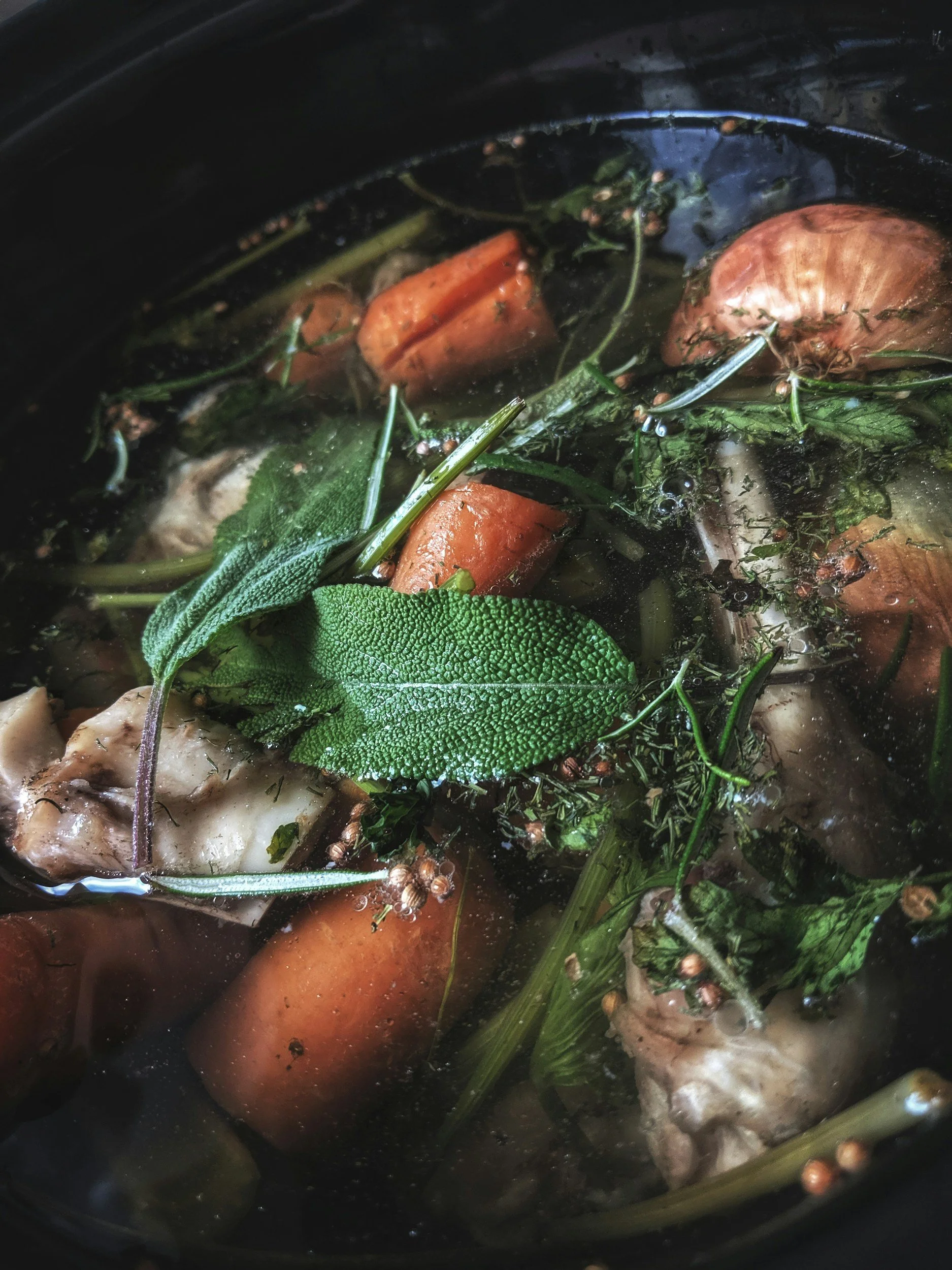
Add the onion, carrots, celery, garlic, bay leaf, and peppercorns. Bring to a gentle simmer, then reduce heat to low. Simmer 12–24 hours (stovetop: 8–12 hours; slow cooker on low: 12–24 hours; pressure cooker: 2–3 hours), skimming any foam that rises in the first hour.
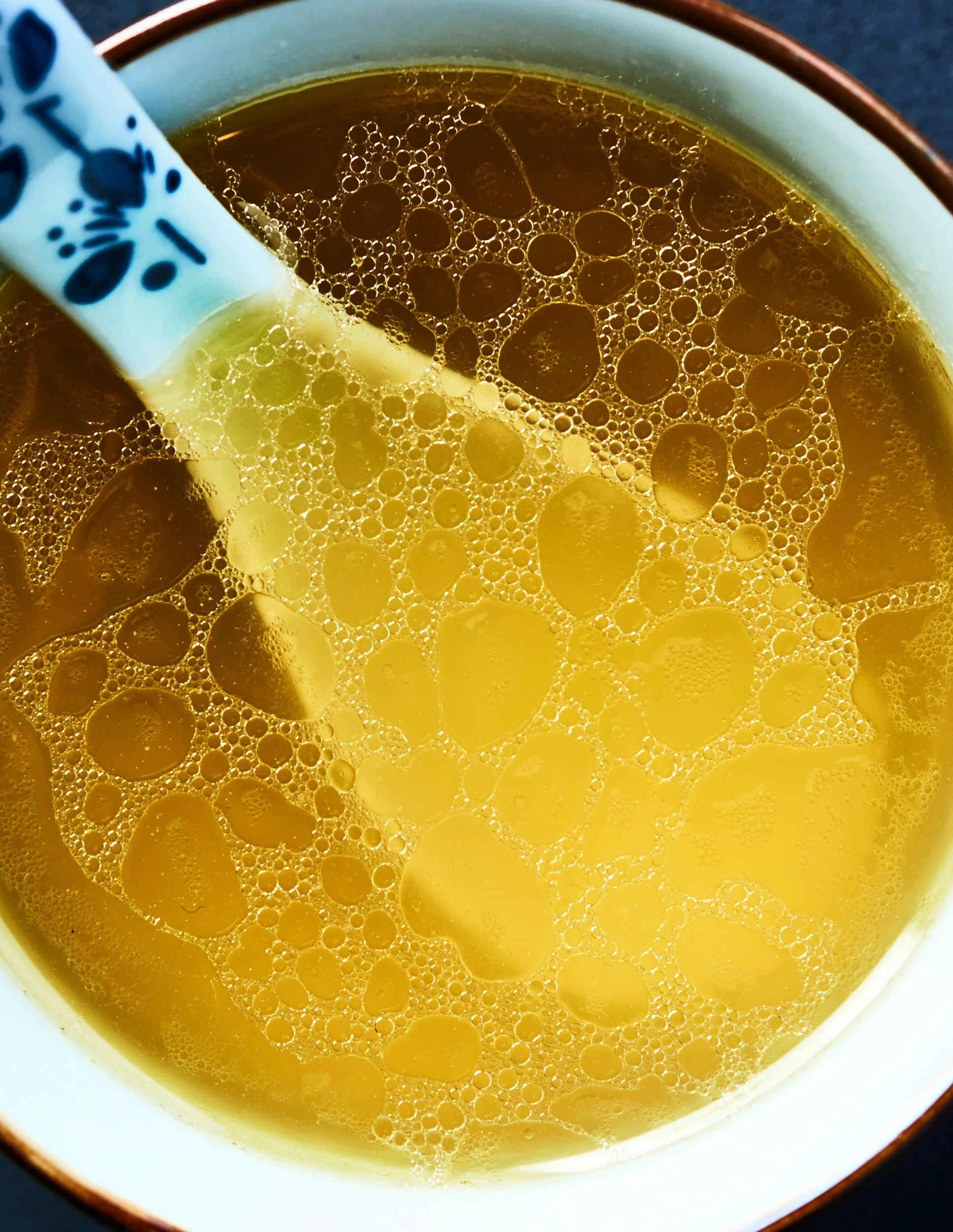
Strain through a fine mesh sieve, discarding the solids. Season with sea salt to taste.
Cool, then refrigerate (up to 5 days) or freeze (up to 3 months).

Recipe 2: Gut-Soothing Ginger Broth
Warming and easy on a tender digestive system — sip this on its own between meals.
Ingredients:
1 batch Classic Bone Broth (recipe above),
strained 1-inch piece fresh ginger,
thinly sliced 1 clove garlic,
smashed1 tsp coconut oil or ghee
Pinch of sea salt
Optional: a few slices of daikon or a handful of well-cooked white rice for a light, congee-like sip
Method
Warm the strained bone broth in a saucepan over low heat.
Add the ginger and garlic and let simmer gently for 10–15 minutes to infuse.
Strain out the ginger and garlic if you prefer a clear sip, or leave them in.
Stir in the coconut oil or ghee and a pinch of salt.
Sip slowly and warm, ideally away from very cold or raw foods that can tax digestion further.

Recipe 3: Golden Turmeric Joint & Bone Broth
Built for comfort in the joints — turmeric and black pepper together, plus extra marrow for collagen.
Ingredients:
1 batch Classic Bone Broth, made with extra marrow bones and 1–2 chicken feet if available (for extra collagen)
1 tbsp fresh turmeric, grated (or 1 tsp ground turmeric)
1/2 tsp fresh ground black pepper (helps the body absorb turmeric's curcumin)
1-inch piece fresh ginger, sliced
1 tbsp olive oil or ghee Juice of 1/2 lemon
Sea salt, to taste
Method
Warm the strained bone broth over low heat.
Add the turmeric, black pepper, and ginger.
Simmer gently for 15–20 minutes.
Strain if desired, then stir in the olive oil or ghee and lemon juice just before serving — this helps with both absorption and flavor.
Season with sea salt and drink warm, ideally daily for several weeks to notice any shift in comfort.
Recipe Reference
Chicken Bone Broth Recipe (Ginger & Turmeric) — Elizabeth Rider
https://www.elizabethrider.com/ginger-turmeric-bone-broth-recipe/

Recipe 4: Bone Broth Congee (Jing-Building Rice Porridge)
A classic Chinese Medicine food for deep nourishment — gentle on digestion, building for Blood and Jing.
Ingredients:
1 cup white or short-grain rice, rinsed
6–8 cups bone broth (Classic recipe above)
1-inch piece fresh ginger, sliced
Optional additions: shredded cooked chicken, a soft-cooked egg, chopped scallion, a drizzle of sesame oil, a few goji berries or jujube dates (traditionally used to build Blood)
Method
Combine the rinsed rice and bone broth in a pot with the ginger.
Bring to a boil, then reduce to a very low simmer. Cook uncovered, stirring occasionally, for 1–1.5 hours, until the rice breaks down into a thick, creamy porridge.
Add more broth or water if it becomes too thick.
Remove the ginger slices.
Stir in any additional toppings and season lightly with sea salt.
Serve warm, especially in the morning or during times of illness, fatigue, or recovery — this is a traditional food for restoring depleted reserves.

Recipe 5: Jing-Restoring Convalescence Broth
A deeply tonifying broth for fatigue, slow recovery, or times when your reserves feel truly depleted — postpartum, post-surgery, post-illness, or simply worn thin.
Ingredients:
1 whole chicken (preferably an older hen if available) or 3 lbs mixed chicken/beef bones with marrow
6–8 dried red dates (jujube), pitted
1/4 cup goji berries
1 oz astragalus root (huang qi), sliced (find at an Asian grocer or herb shop)
4–5 dried shiitake mushrooms
1-inch piece fresh ginger, sliced
2 tbsp black beans, soaked (optional, for extra Jing/Kidney support)
2 tbsp apple cider vinegar
Filtered water to cover
Sea salt, to taste
Method
Place the chicken or bones in a large stockpot or slow cooker. Cover with filtered water and add the apple cider vinegar. Let sit 20–30 minutes.
Add the red dates, goji berries, astragalus root, shiitake, ginger, and black beans if using.
Bring to a gentle simmer, then reduce heat to low. Simmer 8–12 hours (slow cooker on low: 10–12 hours), skimming any foam in the first hour.
Strain, reserving the tender chicken meat and shiitake mushrooms to shred back into the broth if you like a heartier bowl. Discard the astragalus root and ginger.
Season with sea salt. Sip warm, 1–2 cups daily during recovery or whenever fatigue feels bone-deep.
A note on the astragalus root: it's a fibrous, woody root meant to be simmered and removed, not eaten — think of it like a bay leaf. If you can't find it locally, the broth is still nourishing with just the dates, goji, shiitake, and ginger.
A gentle closing
Food medicine is one of the quiet, daily ways we participate in our own healing, and a pot of broth simmering on the stove is a small, steady act of care. If you'd like to talk through how nourishment like this fits into your broader treatment plan — alongside acupuncture, Chinese herbal medicine, or somatic work — I'd love to explore that with you in a session.
Sources
Sources: PubMed (Digestive Diseases and Sciences, 2025), PMC (colitis model study), PubMed (collagen meta-analysis), PMC (hydrolyzed collagen RCT), PMC (Nutrients systematic review), The New York Times, Bones After 50, PubMed (chicken-vegetable bone broth study), Cleveland Clinic, Elizabeth Rider (bone broth recipe reference).